
The Leadership Gap – and How To Fix It
The costly mistake companies keep making when they promote top performers
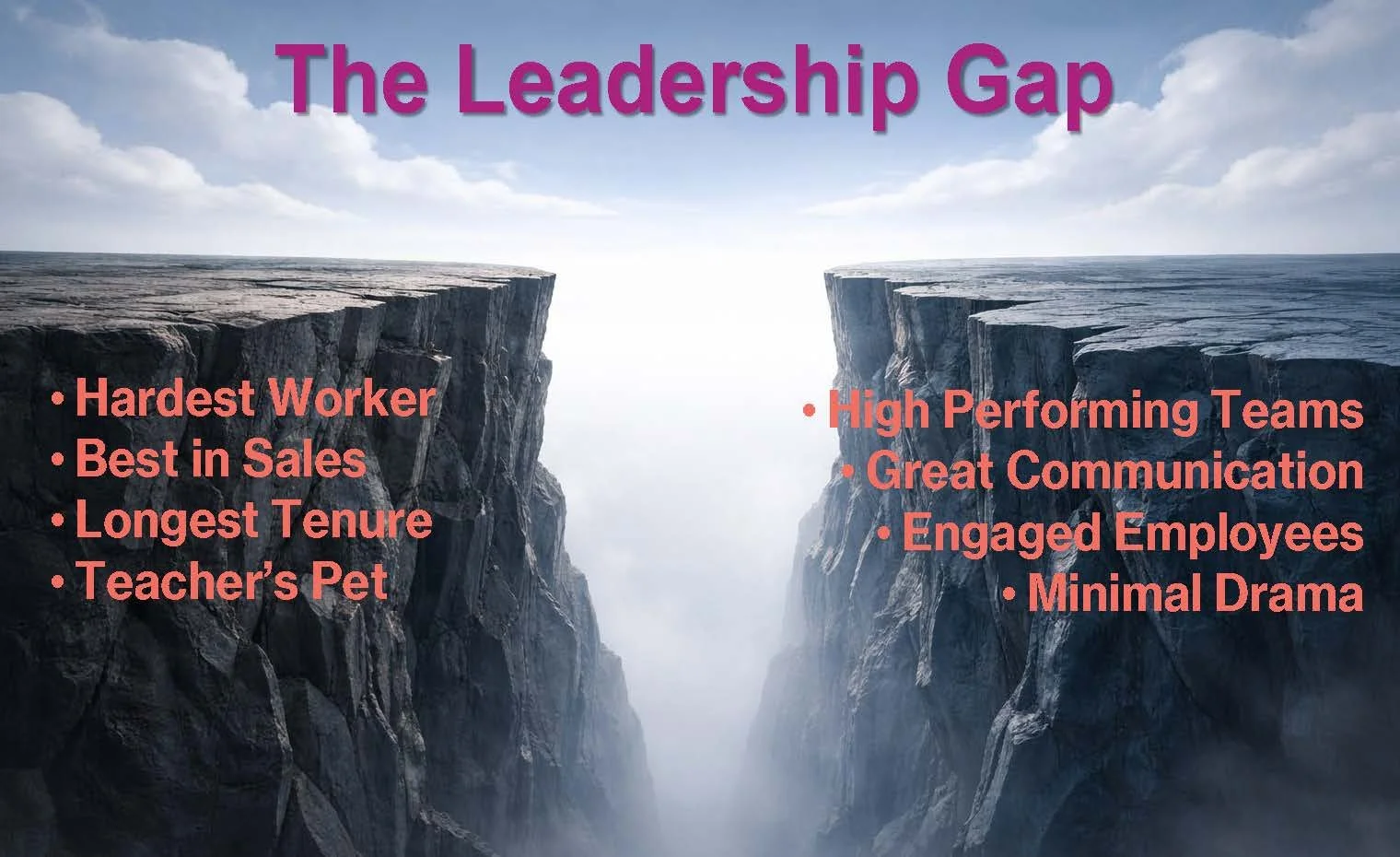
The biggest threat to your organization isn’t turnover, labor shortages, or even the economy.
It’s the growing gap between the people you promote and the leadership you actually need.
That’s the leadership gap. And right now, it’s hurting a lot more organizations than most leaders realize.
Companies tend to promote the hardest worker. The best salesperson. The smartest person in the room. The longest-tenured employee. The dependable veteran. Teacher’s Pet. On the surface, those choices often make sense. But In practice, they create one of the most expensive mistakes an organization can make.
Why? Because being great at your job doesn’t automatically prepare you to effectively lead people.
The skills that make someone a top producer aren’t the same skills required to coach, communicate, develop talent, manage conflict, create accountability, or build trust. Yet many organizations still promote as if those skills will show up once the title changes.
They won’t.
Every business worries that great people will leave. That risk is real.
But the bigger problem today isn’t disengaged employees leaving; it’s disengaged employees staying.
That’s a far more dangerous problem than many leaders appreciate.
When an employee quits, it creates disruption. When an employee stays but stops caring, it creates drag. Effort fades. Initiative slows. Accountability weakens. Innovation stalls. Great employees get frustrated. And too often, the people who should be dealing with these problems are the very managers who were never trained to lead in the first place.
That’s why the leadership gap matters so much.
Gallup finds that 70% of a team’s engagement is attributable to the direct supervisor. That’s an extraordinary number, and it ought to change the way leaders think about management. If a team is energized, accountable, collaborative, and productive, the manager is usually a big part of the reason. If a team is flat, confused, frustrated, or checked out, the manager is often a big part of that too. The direct supervisor is the linchpin of engagement.
That’s also why I think most businesses aren’t focused on the right metrics.
They track turnover. Time-to-fill. Headcount. Vacancy rates. Absenteeism. Those are useful operational metrics. But they don’t tell you whether your managers are equipped to lead. They don’t tell you whether top performers are quietly becoming disillusioned. They don’t tell you whether supervisors are holding meaningful one-on-ones, setting clear expectations, or building accountability. And they definitely don’t tell you whether your culture is being strengthened or weakened at the front line.
If leadership capability is one of the strongest drivers of engagement, performance, and culture, it deserves far more attention than it gets.
So what does it take to bridge the gap?
Stop confusing promotion with preparation.
A promotion isn’t proof that someone is ready to lead. It’s simply a decision to give them the opportunity. What happens next matters much more. Leadership expectations have to become explicit. The conversation can’t just be, “Congratulations, you earned it.” It also has to be, “Here’s what leadership now requires of you.”
There are six leadership expectations that matter deeply in today’s workplace:
Ability to lead change
Ability to develop people
Ability to inspire others
Ability to engender trust
Clear communicator; and
Creating accountability.
Those aren’t side skills. They’re essential to effective leadership.
Leadership development has to become an ongoing process, not an event.
Going to one workshop doesn’t create a strong manager. Reading a book doesn’t create a strong manager. One good quarter doesn’t create a successful manager.
Leadership skill gets built through experience, reinforcement, observation, coaching, follow-up, and real-world application. That’s why I keep pushing structured one-on-ones, regular skill-building, clear leadership expectations, and consistent follow-through. Leadership is ongoing, not an event.
Managers need practical tools for accountability.
This is one of the biggest pain points I hear from employers. Too many managers delay difficult conversations. They tolerate underperformance too long. They hope things improve without intervention. They confuse being nice with being effective. None of that serves the employee, the team, or the organization.
Effective managers don’t wait for problems to become unbearable. They set clear expectations. They hold regular one-on-ones. They address issues early. They build a culture where accountability is normal, not dramatic. Great managers hire brilliantly and fire efficiently. That may sound tough, but it’s actually respectful. Great employees want be around great employees.
We need to think differently about what makes someone promotable in the first place.
For years, employers overvalue output and undervalued the qualities that actually help someone lead. Great leaders have more than just ability. They bring agility, attitude, aptitude, and alignment. Those qualities matter in individual contributors, and they matter even more in future leaders.
Ability, agility, attitude, aptitude and alignment. The last four don’t show up on a resume or a performance review; they have to be developed.
I’d also argue that the next generation of strong managers will need even more. They’ll need emotional intelligence. Leadership presence. Situational awareness. The ability to communicate with clarity in uncertain conditions. Those aren’t “nice to have” qualities anymore. They’ve become essential.
And finally, with all the noise around AI, let’s not forget what technology still can’t do well.
AI can process information. It can summarize. It can automate. It can support decision-making. But it still can’t teach compassion, integrate culture, care in a meaningful human way, exercise nuanced judgment in difficult people situations, build trust, coach employees through growth, or model ethical leadership. The organizations that thrive in the years ahead won’t be the ones that replace managers. They’ll be the ones that build better ones.
So where should employers begin?
Start small but start deliberately.
Identify who’s been promoted in the past two years. Figure out who has never been trained to lead. Clarify three to five non-negotiable leadership expectations. Require regular one-on-one check-ins. Pick one leadership skill to develop this quarter and reinforce it consistently. Those aren’t complicated steps, but they’re powerful ones.
The leadership gap is real. But it isn’t inevitable.
It exists because organizations keep making understandable decisions without building the support structure those decisions require. The good news is that gaps can be bridged. And when they are, the results are significant: stronger supervisors, more engaged employees, healthier culture, better communication, and more consistent accountability.
That’s not just good leadership.
That’s how you build a stronger team, a healthier culture, and a better business.