The Rise of the Reluctant Employee (Part I): Why People Stay… But Don’t Care
The Great Resignation has devolved into The Big Stay. Today’s reality is that half of all workers are disengaged but unwilling or unable to leave their jobs.
The leadership challenge has gone from “how do we retain them” to “how do we get them to be engaged”.
Employees are staying in their jobs, but many have mentally checked out. They’re not quitting — they’re disconnecting. They do just enough not to get fired. They show up but don’t engage. These are the Reluctant Employees.
They’re not toxic. They’re not loud. But they’re dangerous. Because they’re invisible — and contagious.
The means more than 50% of employees are neither great (engaged) or awful (actively disengaged).
Engagement Just Fell Off a Cliff
Only 31% of U.S. workers are engaged — the lowest level in five years.
17% are actively disengaged — meaning they’re working against their organization.
That means more than 50% of employees are neither great (engaged) or awful (actively disengaged). They’re only there to get a paycheck and benefits.
And that’s the biggest leadership challenge today: Identifying (and then fixing) those mediocre employees.
It’s easy for managers to lead great employees, and everyone knows who the bad employees are. It’s that middling middle that’s a problem. They’re not bad enough to get fired, but they aren’t adding to your culture, production, profitability.
What’s happening?
Half of Your Employees Are Job Hunting
Even if they’re not saying it out loud, 50% of workers are watching for or actively looking for a new job. Among younger workers, it’s 60%.
But many won’t actually leave — not yet. They’re stuck in place, unsure about the job market, worried about money, unsure if the grass is greener. So they stay… and disengage.
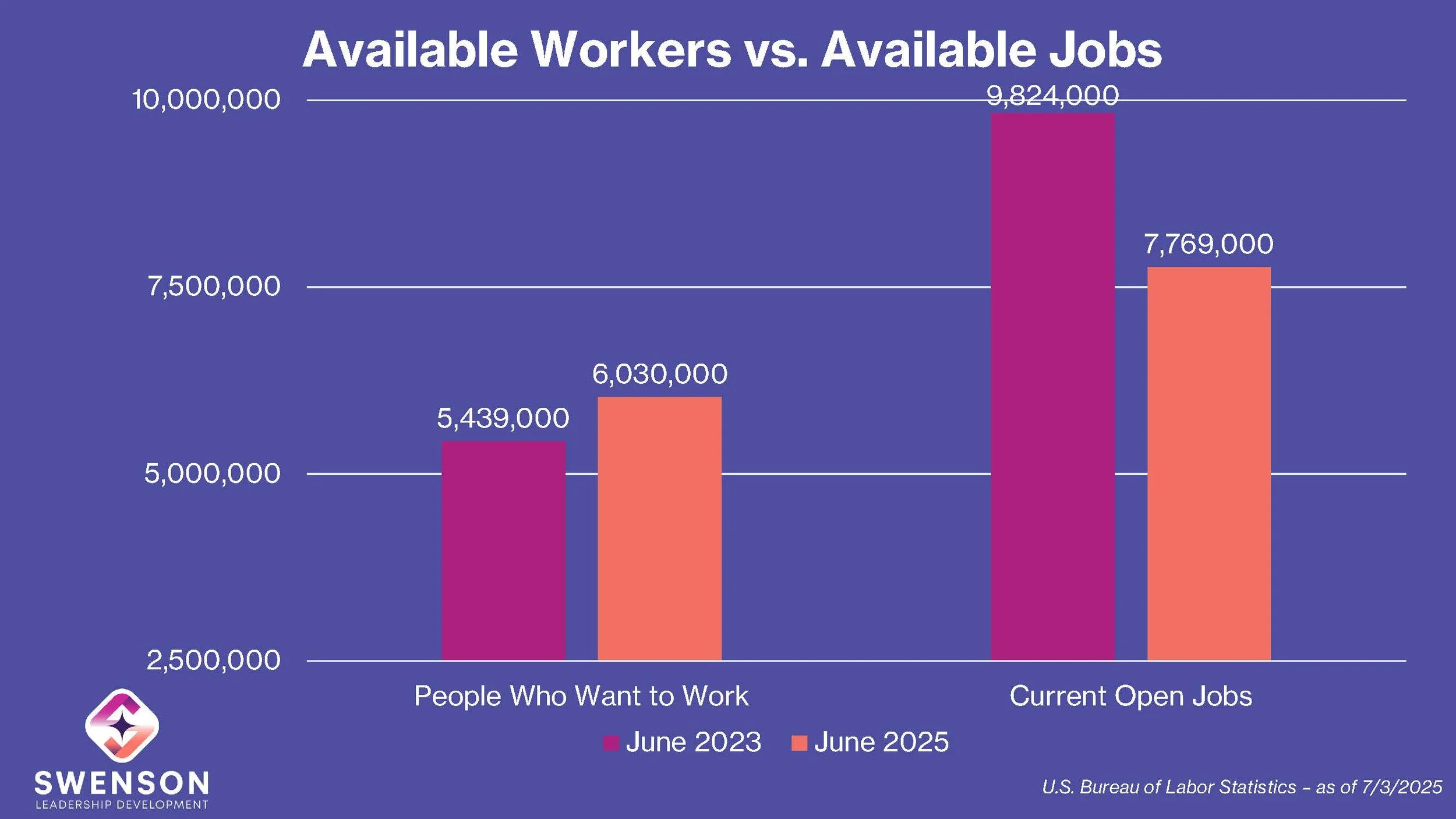
About 600,000 more Americans are looking for work but 2 million fewer jobs are available than two years ago.
There are 21% fewer jobs available in the United States today than two years ago. And there are more people looking for those fewer jobs.
We estimate that 70% of supervisors have been promoted within the past 3 years — without any training in how to lead people.
The U.S. has the highest workplace stress levels in the world — 50% of employees say they were stressed out “a lot of the day yesterday.”
Loneliness, sadness, and anxiety are on the rise, too - especially among remote and hybrid workers.
As a result, we’re seeing:
Productivity lagging.
Teams are quieter.
Initiative is rare.
High performers are burning out — or getting frustrated with the ones who aren’t trying.
It’s not a motivation issue. It’s a system issue.
The Biggest Challenge
It’s literally a management problem:
Just 27% of managers are engaged — and if they’re not in, neither are their teams. 70% of engagement comes from the manager. When managers burn out, teams follow.
Managers are drowning. Young and female managers saw the biggest drops in both engagement and wellbeing.
Flattening = Fewer Managers + More Burden
Many organizations have reduced layers of management to cut costs, speed up decision-making, or streamline operations. On paper, it sounds efficient. In practice, it often leads to:
More direct reports per manager
Less time for coaching and development
No support structure for overwhelmed supervisors
Managers, especially mid-level, are stuck between executive demands and employee needs — with less authority, less support, and more people to manage.
And we estimate that 70% of supervisors have been promoted within the past 3 years – with out any training in how to lead people. (Recent research agrees: there’s been a big uptick in promotions year over year).
But promotion ≠ readiness. Without development, most new managers operate in survival mode.
So How Do We Fix That? I’ll get to that in Part 2.
But for now, leaders need to face a hard truth:
This isn’t about lazy employees. It’s about broken connections — between managers and teams workers and purpose, and performance and recognition.
You can’t fix what you won’t name.
What we’re dealing with isn’t just burnout or disengagement. Those are symptoms.
It’s apathy. It’s erosion. It’s the Reluctant Workforce.
We need to be better.